Visualizzazione post con etichetta Santiago Zabala. Mostra tutti i post

lunedì 25 marzo 2013

Il futuro della religione

In questi giorni post-conclave, nell'ambito del dibattito sul futuro della religione, vi ripropongo qui di seguito il mio intervento su tale argomento al Festival della Filosofia di Torino del 2007. 


Per vedere il video dell'intervista clicca qui (UniNettuno.tv)


Il futuro della religione di R. Rorty, G. Vattimo, S. Zabala (Garzanti, 2005)

giovedì 21 marzo 2013

Del pensamiento débil al comunismo

por Iñaki Urdanibia, Kaosenlared.net
 
Quien fuera, junto a Pier Aldo Rovatti, impulsor del llamado "pensiero debole", reivindica el comunismo y a los gobiernos latinoamericanos que no obedecen a los poderosos. 


No sé qué dirán ahora quienes desde que comenzó a aparecer en las librerías y en los medios de comunicación, hace unos añitos ya, el nombre de Gianni Vattimo (algunos le llamaban ¡vaya-timo!), con su pensiero debole (pensamiento débil) no hicieron otra cosa que insultarle al afirmar que no era más que un representante de la reacción contra-revolucionaria en el campo de la filosofía: sin haberle leído, para nada, enfrentaban su pensamiento fuerte y dogmático, el de los críticos críticos, frente a la debilidad del pensamiento del italiano que no trataba más que debilitar la lucha contra el capital favoreciendo así a los dueños de los medios de producción y las finanzas. 

giovedì 7 febbraio 2013

Vattimo y la crisis


por Andrés Ortiz-Osés (filósofo español)


Es mérito de Gianni Vattimo haber criticado al capitalismo contemporáneo mucho antes de su crisis actual, cuando aparecía como arrogante y casi invencible. Pero en su último libro, escrito con su discípulo Santiago Zabala, el filósofo italiano afila sus argumentos críticos no sólo contra el capitalismo sino también contra la democracia liberal, a la que nuestros autores denominan irónicamente la “democracia emplazada”: emplazada como una empalizada o “fuerte” frente a sus adversarios débiles o debilitados tachados de comunistoides o anarcoides. Pues bien, nuestros autores recogen el reto y se declaran sin complejos como comunistoides y anarcoides, representantes de un comunismo siquiera débil por cuanto pasado por la hermenéutica relativizadora.

Evo Morales, Lula y Hugo Chavez
El libro que comentamos de Vattimo y Zabala se titula precisamente Comunismo hermenéutico (Herder, Barcelona 2012), y en él se defiende frente a la democracia capitalista un comunismo débil. Hablar de comunismo hoy resulta obviamente provocativo de lo establecido, pero también convocativo de la izquierda dispersa, evitando el término conservador de comunitarismo, así como el más atrabiliario de comunalismo. Sin duda los autores agitan el fantasma del comunismo como un espectro o daimon, capaz de poner en solfa al neoliberalismo imperante. Un tal espectro tiene hoy el aspecto del socialismo latinoamericano propio de Lula, Chávez, Morales y demás socios del nuevo comunismo democrático en Sudamérica.

mercoledì 18 luglio 2012

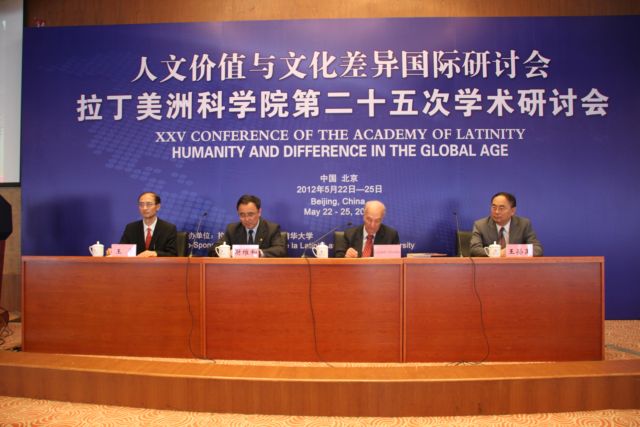
The Academy of Latinity: For a new humanism

(photo: Wang Jing)
Ceasefire magazine, 16 July 2012

Santiago Zabala reports from the Beijing conference of the Academy of Latinity. In a global era when humanity seems to have lost its self-esteem, Zabala writes, the call for a new humanism capable of facing existential annihilation is not only necessary but also urgent.  


Beijing, China— For over a decade the Academy of Latinity has been making a unique contribution against philosophical, political, and religious uniformity that no other institution or establishment can match.
The latest conference took place at Beijing Tsinghua University at the end of May to discuss “Humanity and Difference in the Global Age.” The theme and location of the conference were chosen once again by the distinguished Brazilian intellectual Candido Mendes, the creator and promoter of the meeting series.
The conference was attended by academics and students from all over Asia interested in the profound contributions its participants offered in this twenty-fifth iteration. The program included talks by Susan Buck-Morss, Yang Huilin, and many other prominent intellectuals.
Before exploring the conference’s main highlights, we should recall how this academy was created in 1999 and why it’s so important also for the dialogue with Islam. The Academy’s aim is to promote conferences and publications in favour of a new humanism to overcome the cultural, economical, and linguistic imbalances that result from globalisation’s unjust distribution of knowledge and information.
Balance, according to the founding members (among others, Carlos Fuentes, Gabriel García Marquez, Candido Mendes, Edgar Morin, Jose Saramago, and Gianni Vattimo) can be reestablished through Latinity’s common unita multiplex, that is, the different interpretations that constitute the participants’ background.
When the members met for the first time in 1999 they established that the Academy, in order to function independently, had to become a sui generis institution without governmental support, that is, free of political constraints. The resources of the Academy come from donations and subventions granted by international and national institutions interested in the Academy’s intellectual focus on human dignity as the basis of freedom and democracy.
In a global era when humanity seems to have lost its self-esteem, the call for a new humanism capable of facing existential annihilation is not only necessary but also urgent. For this reason the Academy is represented by the sign of the pomegranate: a fruit that indicates the possibility of renovation through its incorporated seeds and also multiplicity, universality, and, most of all, diversity. As the executive secretary of the Academy, François L’Yvonnet, points out,
“We are actors of a form of diplomacy of thought, a diplomacy of open seas that goes to meet the other who is at the other shore, in a shared refusal of the fatality of an announced world, that of the exclusive kingdom of the fortunate and the powerful. The colloquia of the Academy of Latinity are proportionate to this requirement of the spirit, they give body and life to a true challenge: that of the difference.”
Such diversity is not only thought at the academy but also practised. Its meetings (every six months) take place in different cities and with new participants who share the Academy’s aversion to all sort of cultural discrimination.
This is why after the unjustifiable terrorist attacks of 9/11 and the West’s violent response, the Academy decided to meet in Alexandria (2004), Amman  (2007), and Rabat (2008) in order to intensify its exchange with Islamic culture. These conferences (in which Jean Baudrillard, Boutros Boutros-Ghali, and Alain Touraine also participated) demonstrated how the intellectual exchange between Latinity and Islam creates the basis for a better understanding of Islamic heritage and of the  opposition common to both Islam and the West to the imperial politics of fear that always considers the other or the different an enemy.
At the Beijing conference, the Academy’s “diplomacy of thought,” that is, the thought and practice of difference, was fully realized. Among the many themes discussed particular attention was devoted to the way Chinese intellectuals ought to react to Western cultural imperialism now that we have entered the so-called Dragon Century.
In order to respond to this question it is first necessary to acknowledge, as Wang Ning explained, that even though there has been a strong “Europeanization” or “Westernization” of Chinese culture since the beginning of the twentieth century through a “large-scale translation” of foreign texts, China’s is not a culture that can be “colonized.”
We are dealing here with two completely “different differences.” This is probably why He Xirong emphasised that we ought to remember the ontological distinction between Chinese and Western modes of thinking: while the first emphasises synthesis, induction, and circles, the second uses analysis, clarity, and linearity.
The Chinese civilisation is made of not only different logics, ethnics, and languages but also many “multicentric modernities” within its own boundaries. The geographical differences between Shanghai and Beijing must also include the profound cultural differences between them.
In sum, that today there “is an unbalance in China’s cultural and literary translations” is attributable to the “fact that Chinese people know much more about the West than Westerners know about China” and also arises because “Chinese culture is still in a position of marginality.”
At the conference we all agreed that this position must be restored not because of China’s new economic supremacy but rather in favour of the new humanism the Academy is committed to constructing.
While some participants, in particular Walter Mignolo, consider decolonization a fundamental stage of this new humanism, others, such as Gianni Vattimo, prefer to focus on the hermeneutic nature of (Western) philosophy in order to better understand the Chinese mode of thinking, a mode of thinking, as our Chinese colleagues explained, that seeks “common grounds while keeping differences.”
It is in this spirit of difference that the Academy’s next conference will take place in Oman, where its pomegranate symbol will once again seek to renovate humanism once again through its own incorporated seeds.

Santiago Zabala is ICREA Research Professor of Philosophy at the University of Barcelona. He is the author of The Hermeneutic Nature of Analytic Philosophy (2008), The Remains of Being (2009), Hermeneutic Communism (2011, coauthored with G. Vattimo), editor of Weakening Philosophy (2007), The Future of Religion (2005), Nihilism and Emancipation (2004), Art's Claim to Truth (2009), and co-editor with Jeff Malpas of Consequences of Hermeneutics (2010). Zabala also writes opinion articles and reviews for the New York Times, Al Jazeera, El Pais and other international journals.

martedì 5 giugno 2012

Una recensione di Hermeneutic Communism (Bradley Kaye per Marx&Philosophy)

Review of Books
 
Gianni Vattimo, and Santiago Zabala
Hermeneutic Communism: From Heidegger to Marx

Columbia University Press, New York, 2011. 264pp., $27.50 / £19.00 hb
ISBN 9780231158022

Reviewed by Bradley Kaye
Dr Bradley Kaye is an independent scholar working as an editor at Edwin Mellen Press. He has a Doctorate from Binghamton University’s Philosophy, Interpretation, and Culture Program, and has taught philosophy and sociology at Boston University and Broome Community College.

Review

By attempting a fusion of post-metaphysical thought with the interpretive capabilities of communist criticism, Vattimo and Zabala have accomplished something unique and prescient. Hermeneutic Communism, while being a remarkable accomplishment in the field of Marxist theory, also contains several years’ worth of what one might call observations directed towards contemporary political events. At first, they offer a new approach to the hermeneutical approach to Marx’s famous line, ‘philosophers have only interpreted the world in various ways, the point is to change it’ by claiming this was not a classical refusal of the critical power to interpret. Rather, they hold that Marx meant that the only way actually to change the world is to alter its interpretations.

In this sense, hermeneutics and communism dovetail nicely with one another, by offering philosophies for the weak and the marginal. They maintain that, often in philosophical discourse, there is an illusory antagonism between pursuing the truth and one’s responsibility toward the wider community. To be committed to the truth takes an inquiring mind that does not lose sight of the subject’s engagement with the world as a being among beings involved in it.
This is why they say, “The world of hermeneutics is not an `object’ that can be observed from different points of view and that offers various interpretations; it is a world in continuous revolution” (87). The first thinker to make this radical claim was someone who is often cast as being at odds with communist thinking, viz. Nietzsche. In turning to Heidegger, the conversation becomes subtle in the sense that if there can be a communist hermeneutics, one must start from the presupposition that there is no unified vision of reality. In a purely postmodern move, Vattimo and Zabala offer a heterogeneous anti-essentialist view of what the concept of communism is, not only in theory, but also in practice.

Interestingly, this book was written during the last few years of George W. Bush’s Presidency and the initial phase of Barack Obama’s term in office. The Iraq War had yet to be fully completed, and President Obama had yet to live up to his Nobel Peace Prize. The last section is entitled, “Chavez: A Model for Obama?” with the implication being that true socialism is not necessarily being implemented in America, but rather in Latin America. The chapter which I found to be the most concrete of the book centered around the promise of a new, anti-neoliberal communism emerging that has a hermeneutical inspiration. In this sense, hermeneutical communism runs contrary to the old Stalinist or Maoist universalisms that have “shed blood throughout the world” (138).
In fusing the power of hermeneutical discursive disagreement via a multitude of interpretations playing out differentially, one can surmise that the end result will enhance democratic processes by allowing ‘weak’ voices to be heard. Questioning the social relations of production constitutes the end result of this opening up of democratic discussion, but as the authors point out this does not happen automatically. Anti-foundationalist philosophies must be allowed to flourish in order for this discursive open-mindedness to materialize and gain acceptance. Because of this, there is a lengthy discussion of this process by becoming “unaccustomed to living according to legitimations and grounding values”. Only thus can thought become “post-metaphysical” (100).

By doing this, philosophy becomes conversational rather than tied to meta-narratives which seek to present subjects with timeless, universal, and essentialist Truths. More importantly, the point the authors do not make, but I feel they should, is to think about this hermeneutical discursive process as creating spaces for atomized individuals to form relations of solidarity through singularity, rather than conformity. While they talk extensively about Slavoj Zizek, I believe this work would have benefited immensely from a greater engagement with Alain Badiou. In my opinion, this omission loses sight of some important discussions dealing with the conception of the Event and Singularity that could open up new avenues for a hermeneutical approach to communism on a micro-political, perhaps even inter-subjective level. Vattimo and Zabala do an excellent job discussing macro-politics, and this is an amazing book in dealing with “History” (with an upper-case H) – but it almost never discusses what Gilles Deleuze calls “the fascism of daily life”; and perhaps that was never an important point for them.

It also strikes me as interesting that this book adds to a growing list of recent Marxist texts that turn away from economistic interpretations of revolutionary change. Merely re-appropriating wealth through re-distribution is not enough truly to change the way the Subject’s total immersion in repressive discourses can put a vice-like grip on his or her political imagination. However, there are fundamental flaws in some Marxist rhetoric – rhetoric that amounts to economic vulgarism – which this book addresses.
For instance, the suicide rate among wealthy, unmarried, Protestant (or atheist) white males living in rural environments in America is double the next closest demographic. In fact, black women in America, who constitute the poorest economic class, also constitute the lowest percentage of suicides per capita. So, while most Marxists will continue to bombard us with economistic interpretations of consciousness and subjectivity, the basic unspoken truth that needs to be addressed by all Marxists is a Durkheimian one. Anomic personalities are alienated personalities. This has little to do with economic deprivation, but is due rather to the modern (and postmodern) tendency to wards social normality (anomie) that is exacerbated when a person lives in solitude and has access to a high disposable income without any traditional mores to provide a sense of moral continuity. And in this book there is no discussion of the turn to Liberation Theology in Latin America to fill this long-standing theological and ethical void in Marxist theory.

The biggest problem I see with the assumption that fusing Marxism with postmodernism will provide the magic bullet that will somehow necessitate communism, is this point about anomie. If we open up heterogeneous discourses and democratize all aspects of life, then not only do we lower the bar for creating solidarity movements with some pretty awful people (think: Occupy Wall Street cavorting with heroin addicts and rapists); but also, we fail to conceive of a society based on social stability, and by extension sustainable subjectivities, which produce happy people. Perplexingly enough, I believe talking about happiness and love may actually cause a sense of revulsion among most academic Marxists.

27 February 2012

venerdì 20 aprile 2012

Does Italy Want Berlusconi Back?

Un articolo di Santiago Zabala su AlJazeera, 16 aprile 2012

Does Italy Want Berlusconi Back?

Naples, Italy - It may seem impossible, but many progressive leftist voters in Italy want former Prime Minister Silvio Berlusconi back. They do not miss the embarrassment he created through his lifestyle and inappropriate jokes at institutional meetings (which, as many know, were simply ways to distract our attention from his ongoing legal issues). Rather, they miss the state of political impasse that persisted under his rule considering the ongoing reforms that his successor has imposed.
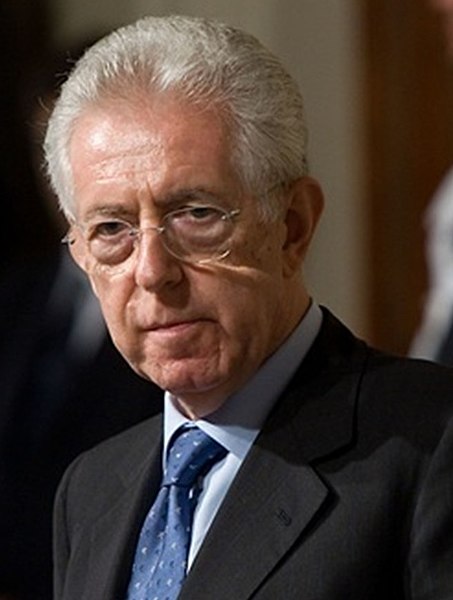
Mario Monti was presented by the President of the Republic as a gentleman, but he also owes his appointment to being seen as an apolitical technocrat capable of solving the gridlock in the country. As it turns out, Monti has actually begun to solve these issues. However, it is not out of interest for the Italian citizens but rather for the European Union and its austerity measures.
If most Italian newspapers have overlooked this fact, it isn't because they are all in favour of the neoliberal EU policies; rather, it is because of Italy's history with his predecessor.

No dialogue
But who is Monti, and why does he leave little or no possibility of dialogue with political parties, unions or civil society? Before been appointed prime minister by the president of Italy last November, Monti served as a European Commissioner, an international adviser to Goldman Sachs, and the rector of Italy's most exclusive private university, the Bocconi.
If Monti today is also endorsed by the international establishment (from the Financial Times all the way to US Treasury Secretary Timothy Geithner), it isn't because he hasn't been charged in underage-prostitute scandals but because of his determination to execute the rules of the international system regardless of the vital demands of his country.
There are two features worth pointing out, given their violent consequences: Imposed labour reform and repression of "No-TAV" (high-speed train) protesters in the Piedmont region near the Italian-French border.
Monti's few months of reform have turned out to be much more harmful than Berlusconi's fourteen years in power, during which he was never able to touch article 18 of the labour statute, which the new prime minister has demolished. This article stipulated a basic principle of workers' rights - that firms must reinstate workers who have been wrongly dismissed - which is vital, considering Italy's fragile social security net.

Self-inflicted depression
Monti's plan is simple: The new flexibility will create new jobs, since companies will finally be able to dismiss and hire new workers when and as often as they wish. There is nothing new in this; he is simply following the demands of the "Troika" (composed of the European Central Bank, the European Commission, and the IMF) for the well-being of the markets, that is, of the self-inflicted depression forced on Europe.
What is alarming are not Monti's plans, which we could all foresee considering his previous appointments, but rather the way he is executing them. The first thing he did after walking away from negotiations with the trade unions was to threaten to dissolve his (unelected) government if the parties (the Democratic Party, the People of Liberty Party, and the Third Way alliance) that sustain him in the parliament did not approve the "reform".


In the same spirit he also discredited, on national television, everyone who aspires for permanently protected jobs, calling the institution "ideological", of the "past", and "monotonous". This lack of dialogue and concern for the well-being of Italians is creating great distress among the population, which has erupted in a number of strikes and riots that are not being covered by most of the Italian press.
The second feature that characterises Monti's pragmatic violence in contrast to Berlusconi's rhetorical deadlock is the recent militarisation of the Val di Susa (an Alpine valley between northern Italy and central Europe) and violence against its citizens. In the 1990s, the Italian government and the EU began the construction of a high speed railway line (TAV) in order to link Turin and Lyon to increase the traffic of goods. The problem with this project is not only the predictable environmental consequences but also that it is unjustifiable given the minimal amount of goods transported by railway nowadays.

Neoliberation obsessions
Against this neoliberal obsession for unfettered development, the "No-TAV" protest movement grew, in order to inform the public of this project - declared unnecessary also by many academics and scientific researchers. Today they can count thousands of members and supporters throughout Italy, including Gianni Vattimo, Italy's most prominent philosopher and an EU deputy, who declared, after the violent police repression of the protest in January, that Monti had to be "fired since the only solution is political, not military".
Monti reacted as any other technocratic politician would and has decided to move along ("it's time for this work") with the construction, regardless of the protesters who blocked roads, railway stations and motorways nationwide early in March. But that is not all. Recently, a secret agreement between Italy and France was unveiled that confirmed both countries' interest in implementing the project, despite the fact that it must first be ratified by both national parliaments.
While Berlusconi threatened to cancel article 18, and move along with the TAV construction for more than a decade, Monti has actually executed both plans after only six months in office. Italy has become a country where the left has almost disappeared from the political scene, and we are left to prefer paradoxically a worthless populist billionaire over a technocratic neoliberal executioner. Imagine it: At the very end, Berlusconi seems to be better than Monti.

Santiago Zabala is ICREA Research Professor of Philosophy at the University of Barcelona. His books include The Hermeneutic Nature of Analytic Philosophy (2008), The Remains of Being (2009), and, most recently, Hermeneutic Communism (2011, coauthored with G. Vattimo), all published by Columbia University Press. You can visit his site here.

sabato 24 marzo 2012

Hermeneutic Communism, la recensione di Ceasefire

“Hermeneutic Communism: From Heidegger to Marx”

CEASEFIRE March 18, 2012. Lev Marder

In 'Hermeneutic Communism', Gianni Vattimo and Santiago Zabala offer a radical recasting of Marx’s theories that openly challenges calls, such as those by Negri and Hardt, for a return of the revolutionary left. Lev Marder argues this could be a Communist Manifesto for the 21st Century. 
 
The great French philosopher Claude Lefort once wrote that the condition for democracy is the “dissolution of the markers of certainty”. He was not exactly referring to the situation of those who are pushed into the widening margins of the world or those who already find themselves in the margins in 2012. How are people to respond to statements made by those in power—those who try to convince citizens around the world to tolerate the sacrifices demanded of them based on a violent, apocalyptic version of truth? The fact that they have to put so much effort into persuasion betrays the questionable credibility of their words. It is enough to mention here the rhetoric leading up to the invasion of Iraq and the 2008 bailout of U.S. banks.
Some recently published works recognise the blatant failures of state leaders to sell their lies and, unsurprisingly, recommend that lies should be told more effectively. And then, of course, there is Hermeneutic Communism co-authored by two distinguished Italian philosophers: Gianni Vattimo (who is also a member of the European Parliament) and Santiago Zabala. While it is for Slovenian philosopher Slavoj Žižek a “book that everyone who thinks about radical politics needs like the air he or she breathes!” for Brazilian investigative Journalist Pepe Escobar it is a “kick-ass manual of radical politics… Occupy Wall Street could also use”.
In essence, Vattimo and Zabala offer a refreshing alternative to the hegemonic discourse, a breath of fresh air from the violent imposition of “metaphysics” by those in power. The book does its best to open the reader’s eyes to the glaring shortcomings of the rhetoric disseminated by the “winners” who have been writing history after the fall of the Berlin Wall:
“In a debate over the end or return of history, Fukuyama and Kagan have engaged in an attempt to present framed democracy as the only legitimate and legitimizing force, regardless of the administration in the White House…It should not be a surprise that [they], together with other establishment intellectuals, forget, neglect, or ignore the oppression caused by neoliberal capitalism. And if they ignore such economic oppression, it is because they themselves sustain it: their condition is also an effect of such oppression.”
Such theories are intended to make other choices harder to see while reinforcing what Vattimo and Zabala call “framed democracy”. They define this framing as being within a discourse of objectivity, metaphysics, and truth. As such, the alignment of “framed democracy” by its proponents with this discourse is intended to preserve the status quo by speaking about it as if it is outside of history—and hence beyond reproach. It is worth acknowledging that with Barack Obama’s election in 2008, a hope existed for change from inside the “framed democracy”. However, after over three years and waves of occupy movements, Vattimo and Zabala write what many in the West are thinking; namely, about how: “within our democratic system change is almost impossible and also how the oppressive effects of capitalism are predicted to increase”.
The alternative the authors offer is lucidly laid out in their revolutionary manifesto for those who feel powerless, that is, the 99% currently, or soon to be, living in the slums. Their call is  a simple and powerful one: Let us abandon the fight for absolute truth, let us reject the terms within which the struggles are framed by those in power, let us embrace interpretation and thus collectively resist on our own terms.
Of course such thinking can be perceived as a retreat, or worse as surrender of territory to the financial institutions that dictate the rules, the governments that claim truth, and the bureaucrats who inhumanely enforce the policies. Yet the genius of these two thinkers is in asserting that for those who are weak, those who are discharged by the system in their words, hermeneutics or weak thought is the alternative. Those in power are the winners and write history while those who are weak “do not possess a different history but rather exist at history’s margins”. If the weak fight by the oppressor’s rules, all kinds of courses of action are precluded and hence “Hermeneutic Communism” lays the fertile ground for practical action on the basis of concrete alternatives.
After thorough criticism of “framed democracy” in the first part of the book, Vattimo and Zabala effectively highlight both the democratising features of interpretation and the hermeneutic features of communism in the second part. By complementing each other, both communism and hermeneutics are weakened to the point where neither theory nor praxis can claim priority; and yet, when combined, they offer a potent alternative for the weak. For Vattimo and Zabala:
“the fact that communism is often presented as tyrannical and hermeneutics is reduced to pure nihilism by their critics is not an indication of their dangers but rather of their ineffectiveness for today’s bearers of power. While the winners of history want the conservation of the world as it is, the losers demand a different interpretation, that is, hermeneutic communism.”
By sketching out a broad agenda in their manifesto, the authors admirably avoid patronisingly prescribing “standardised” actions to those who are weak. Had they done so, they would have merely replaced one oppressive model of “reality” with another. Instead, with modesty and intellectual cogency, the manifesto opens the possibility of weakening the structures that support and enforce oppression. The sense of justice underlying weak thought comes with a repeated relinquishing of the ambition to ever become strong thought.
In Vattimo and Zabala’s words, “weak thought does not become strong once it weakens the structures of metaphysics, since there will always be more structures to weaken, just as there will always be subjects to psychoanalyze, beliefs to secularize, or governments to democratize”.
The authors certainly do not make a weak argument for abandoning old foundations in the 21st century pursuit of these projects and instead giving consideration to Hermeneutic Communism.

Hermeneutic Communism: From Heidegger to Marx
Gianni Vattimo and Santiago Zabala
Cloth, 264 pp
Columbia University Press (October, 2011)
 

sabato 25 febbraio 2012

How to Be a European (Union) Philosopher

Un articolo di Santiago Zabala sul New York Times, 23 febbraio 2012

How to Be a European (Union) Philosopher

One of the motivations behind the creation of the European Union was to assist in the social, economic and individual flourishing of citizens and workers who actually felt European regardless of their birthplace or current residence. I’ve been told that I not only embody such citizenship — I was raised in Rome, Vienna and Geneva, studied philosophy in Turin and Berlin, and now work in Barcelona — but also present a model of a European Union philosopher (because I  promote and teach continental philosophy). While as an E.U. citizen I’m delighted we are all allowed to reside in all these beautiful cities of the continent, as a philosopher I’m alarmed by the E.U.’s ongoing existential exclusions — that is, its forgetfulness of being. I’m not referring simply to a devaluation of the philosopher’s role in society, which is much more pronounced in other parts of the world, but rather something much more vital.

When we speak of being from the existential-hermeneutic point of view, as those interested in philosophy well know, we are not referring to the factual existence of things but rather to the force of the people, thinkers and artists who generated our history. Thus, each epoch can be alluded to in the name that great philosophers have given to being in their work — “act” in Aquinas Middle Ages, “absolute spirit” in Hegel’s modernity, or “trace” in Derrida’s postmodernity. It is between being and nothing. But being also denotes how our existence is hermeneutic, in other words, a distinctive interpretative project in search of autonomous life. We exist first and foremost as creatures who manage to question our own being and in this way project our lives. Without this distinctiveness we would not exist; that is, our lives would be reduced to a predetermined subordination to the dominant philosophical or political system.

The problem in 2012 is that E.U. policies are presented as if we have reached the end of history: after decades of war, Europe is finally united culturally, economically and soon also militarily. This, in the E.U. conception, is the best possible governance we could hope for. But as the ongoing protests throughout Europe point out, history has not ended: as citizens we continue to project our lives in ways that diverge from the Union’s neoliberal game plan. The fact that they are promoting technocratic governance does not imply that the nations of Europe are incapable of governing themselves but rather that they are being trammeled into compliance with the E.U. measures, classifications and rankings.  But where do these rankings come from?

Classification and the creation of hierarchies, whether financial, social or educational, are primarily developments of Western metaphysics, the object-oriented knowledge upon which we have modeled not only science but thought in general. The problem with this model is not theoretical, as we’ve been accustomed to believe, but rather ethical because it obliges intellectuals (whether economist, constitutionalist or philosopher) to leave out those who are not included within the hierarchies. The problem in considering our intellectuals —  “Newtonian physical scientist[s]” as Richard Rorty pointed out — is that this kind of thinker will center social reforms around “what human beings are like — not knowledge of what Greeks or Frenchmen or Chinese are like, but of humanity as such.” But metaphysical concepts such as “humanity” inevitably impose values and beliefs upon those who do not share them, as we’ve experienced with the horrors of colonialism. If so many philosophers at the beginning of the 20th century (Spengler, Popper and Arendt, for example) were concerned with the “total subordination of reason to metaphysical reality” it’s because, as Herbert Marcuse pointed out, it “prepares the way for racist ideology.”

While it would be inappropriate to consider the austerity plans run by the European Central Bank, the European Commission and the International Monetary Fund (recently grouped together as the “troika”) ideologically “racist,” they are certainly “metaphysically violent.” As Paul Krugman explained in a New York Times magazine article a few years ago, the problem with establishment economists is that they mistake mathematics for truth; they are “seduced by the vision of a perfect, frictionless market system [and] need to abandon the neat but wrong solution of assuming that everyone is rational and markets work perfectly.” The economists of the troika are not imposing violent austerity measures simply to politically dominate the European nations but rather to exclude any competing existential project, that is, any alteration to the troika’s vision of “the market.”

These proposed alterations, as Joseph Stiglitz pointed out, are essentially proposals of fiscal stimulus and support for individual citizens who have suffered directly in the financial crisis; but such actions would shake the “measures” of “fiscal discipline” that the European leaders are imposing upon its members. If, for the benefit of the Union, we must submit to measures that inflict social injuries upon our weakest citizens, it’s worth asking whether the euro is worth saving.

The fact that the European Research Council funds predominantly analytic philosophy projects, as well as those subservient to the hard sciences, perhaps is an indication that they prefer intellectuals who submit “reality to reason” rather than fighting the ongoing exclusion of the most vulnerable citizens by those in power. The work of a philosopher in Europe must involve guarding being, namely the existential lives of those not in power, from systems of thought that seek to exclude them. Before the parentheses in this article’s title can be removed, the European Union must reconsider the existential nature not only of citizens but also of philosophy itself since it seems to have forgotten both.
 
Santiago Zabala is ICREA Research Professor of Philosophy at the University of Barcelona. His books include “The Hermeneutic Nature of Analytic Philosophy,” “The Remains of Being” and, most recently, “Hermeneutic Communism,” written with Gianni Vattimo).

giovedì 23 febbraio 2012

Esce "Una filosofia debole": le mie conclusioni

La metafisica è finita, filosofiamo in pace

La conclusione di Vattimo a un volume di saggi in suo onore. Una “questione di metodo” contro ogni pretesa di dominio

La Stampa, 23 febbraio 2012

Un problema preliminare, con cui la filosofia contemporanea non può non fare i conti se vuole esercitarsi ancora come filosofia, e non solo come saggistica o come industriosità storiografica sul pensiero del passato, né ridursi a pura disciplina ausiliaria delle scienze positive (come epistemologia, metodologia, logica), è quello posto dalla critica radicale della metafisica. Bisogna sottolineare qui l’aggettivo «radicale», perché solo questo tipo di critica della metafisica costituisce davvero un problema preliminare ineludibile per ogni discorso filosofico consapevole della propria responsabilità. Non sono radicali quelle forme di critica della metafisica che, più o meno esplicitamente, si limitano a considerarla come un punto di vista filosofico fra altri, una scuola o corrente, che per qualche ragione filosoficamente argomentata bisognerebbe oggi abbandonare. […]

La critica della metafisica è radicale, e si presenta come un problema preliminare ineludibile, una vera e propria «questione di metodo», là dove si formula in modo da non colpire solo determinati modi di far filosofia o determinati contenuti, ma la stessa possibilità della filosofia come tale, come discorso caratterizzato da un suo statuto logico e anche, inseparabilmente, sociale. Il maestro di questa critica radicale della metafisica è Nietzsche. Secondo lui, la filosofia si è formata e sviluppata come ricerca di un «mondo vero» che potesse fare da fondamento rassicurante alla incerta mutevolezza del mondo apparente. Questo mondo vero è stato di volta in volta identificato con le idee platoniche, con l’aldilà cristiano, con l’ a priori kantiano, con l’inconoscibile dei positivisti, finché la stessa logica che aveva mosso tutte queste trasformazioni - il bisogno di cercare un mondo vero autenticamente tale, capace di resistere alle critiche, di «fondare» - ha condotto a riconoscere la stessa idea di verità come una favola, una finzione utile in determinate condizioni di esistenza; tali condizioni sono venute meno, e questo fatto si esprime nella scoperta della verità come finzione.

Il problema che Nietzsche vede aprirsi a questo punto, in un mondo dove anche l’atteggiamento smascherante è stato smascherato, è quello del nichilismo: dobbiamo davvero pensare che il destino del pensiero, una volta scoperto il carattere non originario, ma divenuto e «funzionale», della stessa credenza nel valore della verità, o della credenza nel fondamento, sia quello di installarsi senza illusioni, come un «esprit fort», nel mondo della lotta di tutti contro tutti, nel quale i «deboli periscono» e si afferma solo la forza? O non accadrà piuttosto, come Nietzsche ipotizza alla fine del lungo frammento sul Nichilismo europeo (estate 1887), che in questo ambito siano destinati a trionfare piuttosto «i più moderati, quelli che non hanno bisogno di principi di fede estremi, quelli che non solo ammettono, ma anche amano una buona parte di caso e di assurdità»?

Nietzsche non sviluppa molto di più questa allusione ai «più moderati», ma è probabile che, come appare dai suoi appunti degli ultimi anni (gli stessi da cui proviene questo frammento sul nichilismo), l’uomo più moderato sia per lui l’artista, colui che sa sperimentare con una libertà che gli deriva, in definitiva, dall’aver superato anche l’interesse alla sopravvivenza. […]

La questione circa la fine della metafisica, la sua improseguibilità, non è ineludibile solo o principalmente in quanto si riesca a dimostrare che essa costituisce il movente, esplicito o implicito, delle correnti principali della filosofia novecentesca; ma soprattutto perché pone in discussione la stessa possibilità di continuare a filosofare. Ora, questa possibilità non è minacciata tanto dalla scoperta teoretica di altri metodi, altri tipi di discorso, altre fonti di verità ricorrendo alle quali si potrebbe fare a meno di filosofare e di argomentare metafisicamente. Ciò che getta una luce di sospetto sulla filosofia come tale e su ogni discorso che voglia riprenderne su piani e con metodi diversi le procedure di «fondazione», di afferramento di strutture originarie, principi, evidenze prime e cogenti, è la smascherata connessione che queste procedure di fondazione intrattengono con il dominio e la violenza.

Il riferimento a questa connessione, sebbene possa apparire accidentale, è invece quello che, preso sul serio, rende davvero radicale la critica della metafisica; senza di esso, tutto si riduce a sostituire semplicemente alle pretese verità metafisiche altre «verità» che, in mancanza di una dissoluzione critica radicale della stessa nozione di verità, finiscono per riproporsi come istanze di fondazione. È difficile, come pure si sarebbe tentati di fare richiamandosi a Hegel, opporre a una tale «questione di metodo» l’invito a provare a nuotare gettandosi in acqua, cioè a cominciare di fatto a costruire argomentazioni filosofiche cercando se non sia possibile, contro ogni eccesso di sospettosità, individuare alcune certezze sia pure relativamente «ultime» e generalmente condivise. Tuttavia l’invito a gettarsi in acqua, l’invito a filosofare,non può provenire dal nulla; esso si richiama necessariamente all’esistenza di una tradizione, di un linguaggio, di un metodo. Ma le eredità che riceviamo da questa tradizione non sono tutte equivalenti: tra di esse c’è l’annuncio nietzschiano della morte di Dio, la sua «esperienza» più che teoria, della fine della metafisica e, con essa, della filosofia.

Proprio se si vuole accettare la responsabilità che l’eredità della filosofia del passato ci impone, non si può non prendere sul serio anzitutto la questione preliminare di questa «esperienza». Proprio la fedeltà alla filosofia è ciò che impone di non eludere, anzitutto, la questione della sua negazione radicale; questione che, come si è visto, è indistricabilmente connessa a quella della violenza.
Gianni Vattimo

mercoledì 22 febbraio 2012

Una filosofia debole

Zabala Santiago
Una filosofia debole

Saggi in onore di Gianni Vattimo

Traduzione dall'inglese di Lucio Saviani

510 pagine

€ 45.00
ISBN 978881160054-1


Gianni Vattimo è uno dei filosofi più importanti sulla scena internazionale. Le sue opere sono tradotte in tutto il mondo. Per celebrare il suo percorso filosofico, pensatori come Umberto Eco, Richard Rorty, Charles Taylor e molti altri hanno voluto dibattere i temi da lui affrontati. Muovendo dal decostruzionismo di Derrida e dall'ermeneutica di Ricoeur e sulla base della sua esperienza di uomo politico, Vattimo si è interrogato sulla possibilità di parlare ancora di imperativi morali, di diritti individuali e di libertà politica, e ha proposto la filosofia di un pensiero debole che mostra come i valori morali possano esistere senza essere garantiti da un'autorità esterna. La sua interpretazione secolarizzante scandisce elementi anti-metafisici e pone la filosofia in relazione con la cultura postmoderna.

Nel volume i contributi di Rüdiger Bubner, Paolo Flores d'Arcais, Carmelo Dotolo, Umberto Eco, Manfred Frank, Nancy K. Frankenberry, Jean Grondin, Jeffrey Perl, Giacomo Marramao, Jack Miles, Jean-Luc Nancy, Teresa Oñate, Richard Rorty, Pier Aldo Rovatti, Fernando Savater, Reiner Schrümann, James Risser, Hugh J. Silverman, Charles Taylor, Gianni Vattimo, Wolfgang Welsch, Santiago Zabala.

venerdì 10 febbraio 2012

Being a communist in 2012

Al Jazeera.com, 9 febbraio 2012
Being a communist in 2012 is not a political choice, but rather an existential matter, writes Santiago Zabala.

Barcelona, Spain - Being a communist in 2012 is not a political choice, but rather an existential matter. The global levels of political, economic and social inequality we are going to reach this year because of capitalism's logics of production not only are alarming, but also threaten our existence. Unfortunately, war with Iran is likely to begin, public protest might increase throughout the West because of government austerity programmes, and these very disorders will probably be suppressed with sophisticated high-tech weapons.
These issues are existential; that is, they touch our Being. And as philosophers (sometimes called the "shepherds of Being"), we must fight against Being's ongoing annihilation. Certain contemporary philosophers ignore this vital matter in favour of technical, artificial or analytic problems not only because of the short-term profit they can obtain from them, but also because they are themselves already annihilated, an annihilation brought about by their obliviousness to existential questions, the question of Being.
This question is still crucial for philosophers, because it characterises all the other problems, and it determines them. For example, the solution to most technical problems are already available in the prejudices, history and culture that characterise a thinker's life, but the technical philosopher forgets that his life is the fundamental starting point for his investigations. This is why so few analytic philosophers comment on great sociopolitical events such as 9/11 or the current economic crisis: they believe philosophy has nothing to do with our existence in this world.
However, for readers of Al Jazeera still interested in the existential nature of philosophy, where our own Being is always at stake, communism might become a way to return to philosophy's original sociopolitical task. After all, it should not be a surprise that distinguished contemporary philosophers who focus on existential matters (such as Alain Badiou, Gianni Vattimo and Slavoj Zizek) have also reconsidered the meaning of communism for this new century.
While some might argue that it is not necessary to turn to communism in order to recognise these existential emergencies, it might turn out to be a useful practical theory given the meaning it has acquired today. As the late French philosopher Jacques Derrida explained, communism, together with Being, is a remnant of the past, the specter of a conquered fear overcome by Western capitalism and the artificial annihilation of philosophy.
It is precisely in its great weakness as a political force that communism can be recuperated as an authentic alternative to capitalism. But the fact that it has virtually disappeared from Western politics, that is, as an electoral programme, does not imply it is not valuable as a social motivation or alternative. The point I wish to make is that being a communist (or a protester) today is not only necessary given the existential threats posed by capitalism, but also actually possible because of the failure of Soviet communism.
Contrary to the opinion of most disillusioned Marxist, it is just this historical defeat that constitutes communism's greatest possibility to redeem itself not only as a political force, but also as the salvation of human beings in the 21st century. Instead of pursuing once again the contest against capitalism for unfettered development, weak communism can now embrace the cause of economic degrowth, social distribution and dialogic education as an effective alternative to the inequity that global capitalism has submitted us to.
This is probably why Eric Hobsbawm has suggested that the communism of the 21st century must become first and foremost a
critique of capitalism, critique of an unjust society that is developing its own contradictions; the ideal of a society with more equality, freedom, and fraternity; the passion of political action, the recognition of the necessity for common actions; the defence of the causes of the poorest and oppressed. This does not mean anymore a social order as the Soviet one, an economic order of total organisation and collectivity: I believe this experiment failed. Communism as a motivation is still valid, but not as programme. (E. Hobsbawm, "El comunismo continúa vigente como motivación y como utopía," interview by Aurora Intxausti, El Pais, April 12, 2003)
The weakened communism we are left with in 2012 does not aspire to construct another Soviet Union, but rather proposes democratic models of social resistance outside the intellectual paradigms that dominated classical Marxism. These paradigms have been overcome because Marxism has gone through a profound deconstruction that has contributed to dismantling its rigid, violent and ideological claims in favour of democratic edification. Being weakened from its own scientific pretexts for unfettered development allows communism to finally unite together its supporters. But who and where are the supporters of a weak communism?
As I have explained elsewhere with Gianni Vattimo, the remains of communism are constituted of everything that is not framed within "the iron cage of capitalism," as Max Weber used to say, that is, at its margins. These are the slums, underdeveloped nations and un-useful shareholders who, despite the fact they represent three-quarters of the world's population, are being annihilated existentially through economic and military oppression.
In response, social movements, especially in South America, have begun to fight back by electing their own representatives (Lula, Morales, and many others) in order to defend the Being of the weak and apply much-needed social reforms. As it turns out, the shapers of these new political alternatives have managed to defend not only their own existential interests, but also our own through the pressure they have recently exerted against a military intervention in Iran or the WB's economic impositions.
These democratically elected governments show an alternative model that the West could follow in order to escape the ongoing annihilation of human Being. It is interesting to note how the mainstream media portray as "communist" the OWS movement and the Spanish indignados for their anti-capitalist demands - although it is not entirely accurate. In doing so, they are trying not only to mock these protesters' demands, but also to annihilate their view from the consent of public opinion. Being a communist in 2012 is a way to avoid being annihilated, a way to escape the annihilation of Being in the world.

Santiago Zabala is ICREA Research Professor at the University of Barcelona. His books include The Hermeneutic Nature of Analytic Philosophy (2008), The Remains of Being (2009), and most recently, Hermeneutic Communism (2011, co-authored with Gianni Vattimo), all published by Columbia University Press. His webpage is www.santiagozabala.com.

giovedì 8 dicembre 2011

Santiago Zabala: "A Philosophy for the Protesters"

A Philosophy for the Protesters
The OWS movement grew out of the philosophical paradox that our financial system could not contain flaws.

Santiago Zabala, Nov. 30, 2011
AlJazeera.com

Barcelona, Spain - A few weeks ago, after participating at a conference at Stony Brook University in New York, I went to Zuccotti Park to see and support the protesters there. A few months earlier, I had done the same thing, but in Placa de Catalunya in Barcelona; in both parks, where similar dissatisfaction with our world order was being expressed, the only thing I could think of was the actuality of Karl Marx's words of 1845: "Philosophers have only interpreted the world in various ways; the point is to change it". How can these words still be valid today? Is there a philosophy for these protesters?
Regardless of all the great work that philosophers have done since Marx, this change has still not come about. The reason does not rest in philosophers' inability to interpret correctly, but rather in their desire to interpret correctly. The inability to effect change that concerned Marx cannot be attributed to interpretation but to the truth that interpretation seeks, that is, to descriptions. Descriptions demand the imposition of certain truth and the conservation of reality, the status quo. Interpretation, on the other hand, constantly makes new contributions to reality, constantly produces change. Marx's call to change the world should be read against those philosophies incapable of producing change, those that sustain the current constitution of society, politics and, most of all, the economy. These philosophies are primarily practiced in the United States under the name of "metaphysical" or "analytical" philosophy, and star representatives include, among others, Robert Nozick, Francis Fukuyama and John Searle. While Nozick and Fukuyama defend neoliberalism and its triumph over history, Searle (who was honoured by George W. Bush in 2004 with a National Humanities Medal) focuses on a defence of reason and objectivity and so acts to conserve the current condition of the world.
In the midst of our global economic crisis, which sees financial centres such as Wall Street occupied by protesters who call for change, Marx's statement points out that we are still framed within the thought system that sustains the crisis, but it also demands a change in thought, that is, a philosophy for these same protesters. This philosophy is available and is called hermeneutics, the philosophy of interpretation that runs proximally through history from Aristotle and Augustine to Paul Ricoeur and Hans-Georg Gadamer. Although Plato in the Ion presented hermeneutics as a theory of reception and practice for transmitting the messages of the gods of Olympus, it soon after acquired a broader philosophical significance, suggesting alternative vital meanings for world, thought and existence. Thus, its most important living representative, Gianni Vattimo, recently pointed out how "whoever does not succeed in becoming an autonomous interpreter, in this sense, perishes, no longer lives like a person but like a number, a statistical item in the system of production and consumption". The protesters and movements that arose in Spain last spring and have now spread throughout the world are the incarnation of these autonomous interpreters determined to overcome the economic impositions established by our governments. But what grants them this determination is not possession of a higher truth than the one espoused by the bearers of power, but rather the idea of an alternative and socially balanced organisation of wealth, that is, a different interpretation of the world.
Clicca sull'immagine per visitare il
Live Blog Occupy di Al Jazeera
But the parallel I am trying to establish between our protesters and the philosophy of interpretation does not rest simply on their demand for change but also on the condition in which they find themselves. Both the protesters and hermeneutics exist at the margins of society, as a sort of discharge of capitalism, on the one hand, and a second-rate philosophy, on the other. This marginalised condition is a consequence not of political or theoretical inconsistence, but rather of their vital ethical demands. Like Marx, hermeneutic thought and the protesters pose a radical demand for change. Rarely do people comfortable in their lives propose a different interpretation of reality, but when they do, it becomes politically revolutionary because it opposes the objective state of affairs that conditioned his previous existence. The demands of our protesters in Barcelona, New York and Sydney vary from equal distribution of income, greater social services, to reduction of corporations influence on politics, but this does not indicate they are conflicting, confused, and anarchic but that they are all hungry for change. But why is hermeneutics the most appropriate philosophy for these protesters who seek to change real economic policies?
Joseph E. Stiglitz
If hermeneutics can become the philosophy of our protesters it is not only because it shares a discredited condition, revolutionary goals or ethical resistance, but also because it suggests that human coexistence is possible without imposed truth, that is, a single global financial system. After all, according to Joseph Stiglitz, Paul Krugman, and other distinguished economists, it is just this belief in a global economy that drove us into financial crisis in the first place. The IMF, WB and ECB are founded on a "pensee unique," that is, an ideology of perfection, rationality, and self-regulation where flaws, frictions and failures cannot even be taken into consideration. Imposing as truth the specific economic policies of these organisations is to the life embodied by our protesters, a life that shows different and differently vital cultural and economic demands. Hermeneutics, then, is one of the few philosophies that reflects the pluralism of our postmodern societies because, like truly democratic procedures, it includes and allows structural changes to take place every time citizens demand them. Ignoring these demands for change overlooks new, different, and vital interpretations and also ignores the 99 per cent of the population that is now demanding them and the change they can effect.

Santiago Zabala is ICREA Research Professor at the University of Barcelona. His books include The Hermeneutic Nature of Analytic Philosophy (2008), The Remains of Being (2009), and, most recently, Hermeneutic Communism (2011, co-authored with Gianni Vattimo), all published by Columbia University Press. His webpage is www.santiagozabala.com
The views expressed in this article are the author's own and do not necessarily reflect Al Jazeera's editorial policy.